
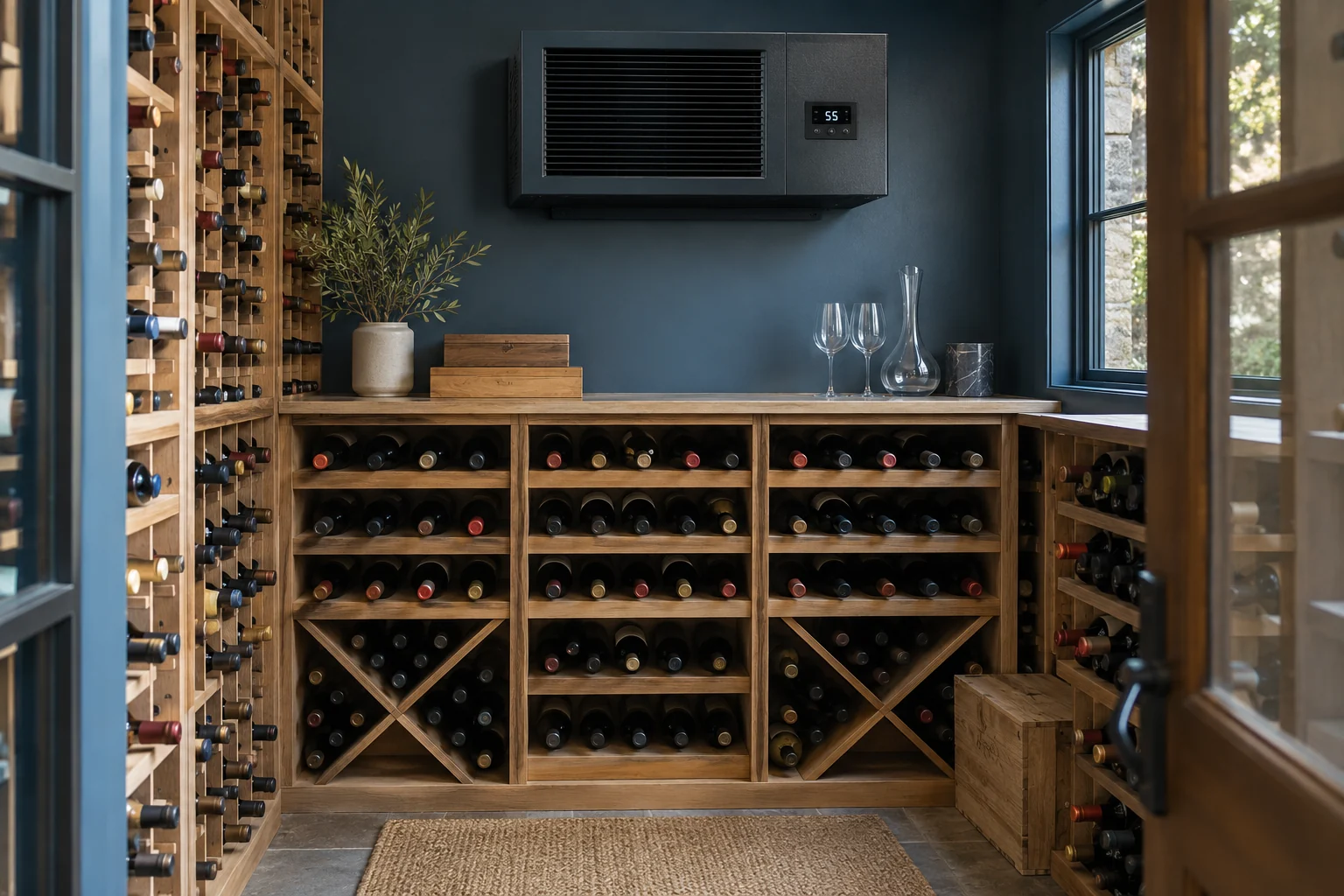
Wine cellar cooling · Edmond & Oklahoma City
CellarPro wine cellar cooling repair in Edmond & Oklahoma City
Cellar creeping past 60°F, an alarm code on the display, or water under the unit? We repair CellarPro self-contained units, split systems and air handlers in your home, and you get a written estimate before any work starts.
★ 5.0 average rating · 2,500+ five-star reviews across Google, Facebook, Angi, Nextdoor & more
Open 7 days, 9 AM–6 PM · Service call fee waived with completed repair.
Know your system
Which CellarPro do you have?
CellarPro builds four kinds of cooling system. Each one gets rid of its heat in a different place, and that decides where we work and what usually goes wrong.
1800 Series
1800QTL · 1800QT · 1800XT · 1800XTS · 1800XTSr · 1800XTSx
Compact self-contained units for wine cabinets and cellars up to about 400 cubic feet. The cold side faces the cellar and is never ducted.
Where the heat goes
Out the back or top into the next room, or through a 6-inch duct kit. The 1800XTSr breathes from its front and can’t be ducted.
Watch for
HA2 alarms when the room behind it gets hotter than 95°F (85°F for the 1800XTSr).
Houdini
1800H · 3400H
Made for shallow cellars. It can hang inside the cellar, sit in the ceiling joists above it, or work from another space through ducting.
Where the heat goes
Up into the space above the cellar, or through ducting.
Watch for
Water. A heated stainless pan evaporates what the unit collects, but a leaky cellar can make more than it can handle. The 1800H overflow line runs without a trap.
VS and VE Series
2000VS · 3200VS · 4200VS · 6200VS · 8200VS · 3200VE · 4200VE
Larger self-contained units. VS models cover cellars up to about 2,200 cubic feet with variable-speed fans; VE models cover up to 1,000. Both are rated for intake air up to 110°F.
Where the heat goes
Out the back, often through ducting to a garage, attic or outdoors.
Watch for
Long or restricted duct runs that starve the hot side of air. Models ending in “i” are indoor units and “x” are outdoor units.
Split systems and air handlers
3000S · 4000S · 6000S · 8000S · AH6500 · AH8500
A quiet evaporator stays in or near the cellar and a condensing unit sits in a garage, attic or outside, joined by copper refrigerant lines. Air handlers are ducted and come self-contained or split.
Where the heat goes
Wherever the condensing unit is, in air up to 110°F.
Watch for
A condensing unit that keeps running after the cellar side stops, which ices the coil, and leaks in the copper lines.
Find the model on the label
CellarPro prints the model and serial number on a label on the side of the unit. Once a unit is built into a wall, that side can be hard to reach, so check your install paperwork too. Send us the model and a photo of the display when you call.
Display codes
What the CellarPro display is telling you
When something is out of range, a CellarPro control flashes a code and sounds an alarm. Here is what each code means in CellarPro’s own manuals, and what to do about it.
Codes and settings vary by model and control version. Before you switch anything off, write down exactly what the display shows and whether it is flashing. Then call (405) 534-4788.
Oklahoma conditions
Hot garages and cold winters are hard on the hot side
A wine cellar cooler works like a small air conditioner. It pulls heat out of the cellar and gets rid of it on the other side of the wall. If the air on that side is too hot, too cold or has nowhere to go, the unit protects itself and the cellar warms up.
Summer: HA2 season
Oklahoma City averages about 11 days a year at 100°F or hotter, and an attic or garage can run hotter still. That is where HA2 alarms come from.
What helps: the hot-side fan on high, an exhaust space at least as large as the cellar, and 8 inches of open air around every vent.
Winter: LA2 season
An unheated garage or an outdoor unit can drop below 40°F, the point where CellarPro calls for a compressor heater. Below 20°F it needs a fan cycling switch as well.
What helps: intake air from a heated space, or a cold-weather kit. On the 1800 Series the heater is fitted at CellarPro’s factory; on VS, split and air-handler units it can be added to the unit.
Intake air each CellarPro is built for
1800 Series
40°F to 95°F · 85°F max on the 1800XTSr
1800H Houdini
40°F to 95°F with the hot-side fan on high
VS and VE
Up to 110°F
Split condensing units
0°F to 110°F, with a compressor heater below 40°F
Colder than 40°F
Compressor heater; below 20°F add a fan cycling switch
From CellarPro’s spec sheets and manuals. Limits vary by model, so we check yours.
Call (405) 534-4788Before you call
Five checks you can do safely
These come from CellarPro’s own guidance. None of them need tools or opening the case.
1
Write down what the display shows
The code, the cellar temperature and the set point. A photo of the front of the unit and its label is even better.
2
Look at the hot-side fan
On a self-contained unit, the fan outside the cellar should spin whenever the fan icon on the display is lit. If it doesn’t, switch the unit off.
3
Check the intake filter
Aluminum and vinyl filters wash in warm, soapy water. Fiberglass filters are replaced every 6 to 9 months. Use CellarPro filters only.
4
Give it room to breathe
Keep at least 8 inches clear in front of every vent, and make sure the hot exhaust isn’t looping back into the intake.
5
Wait out the start delay
After the power comes back, a CellarPro waits 3 minutes before the compressor starts (split systems can be set to 30). A newly loaded cellar can also run nonstop for up to a week.
Once a cellar has settled, running about three quarters of the time is normal for a CellarPro, according to its manual. Running nonstop for days in a cellar that used to cycle is not.
Switch it off and call us if…
Never turn a CellarPro upside down. If a unit has to come out of the wall, it stays upright.
Call (405) 534-4788Open 7 days, 9 AM–6 PM
What we fix
CellarPro repairs we handle in your home
Most CellarPro calls come down to airflow, sensors, drainage or the sealed refrigeration system. We test before we replace anything.
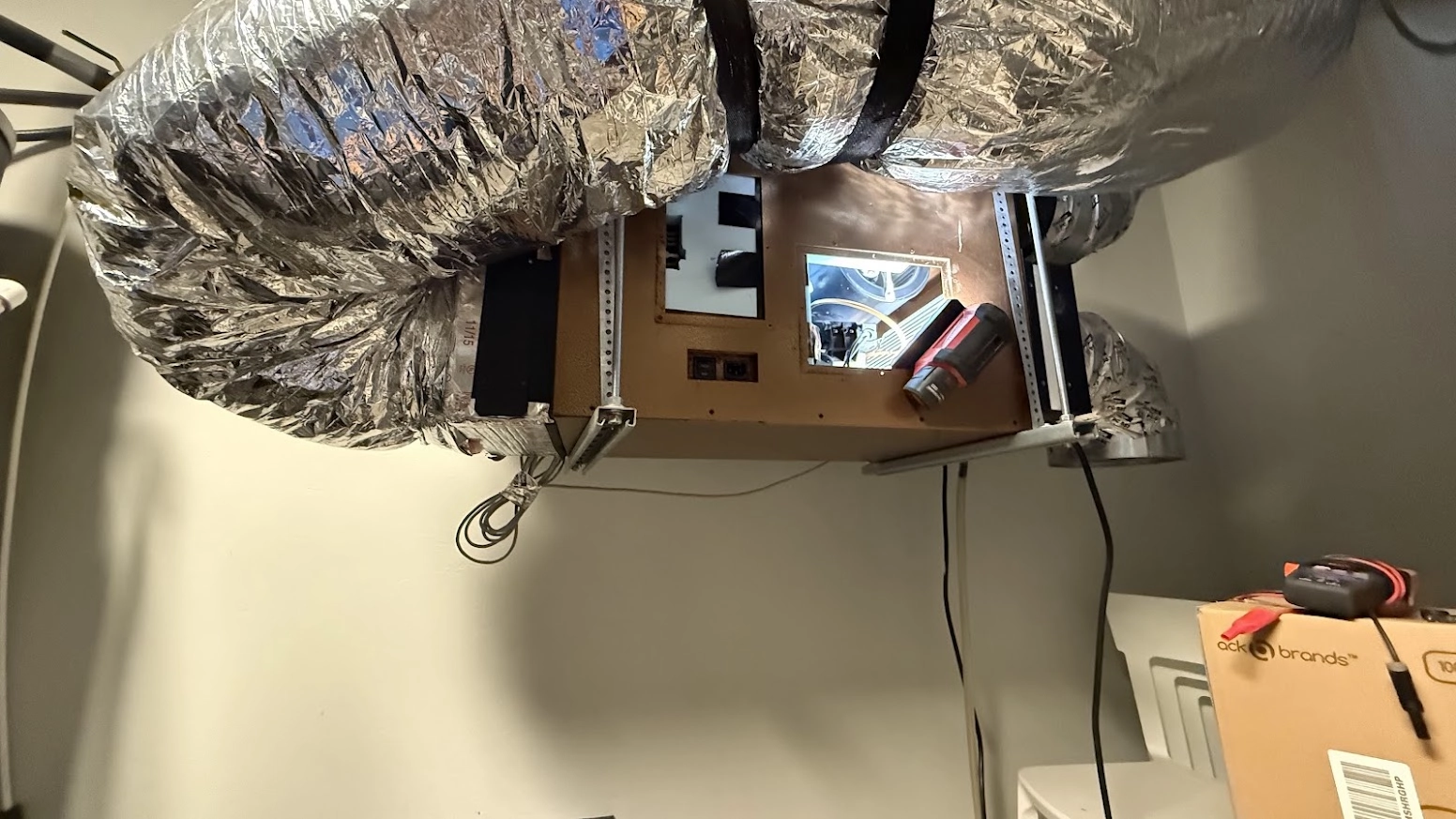
A ducted cellar cooling system opened up for testing. Ducted and split units often sit in a closet, attic or garage, so tell us where yours is when you call.
Fans and fan motors
Hot-side condenser fans behind HA2 alarms, and cold-side evaporator fans behind icing and weak airflow.
Probes and controls
P1, P2 and P3 sensor faults, loose terminal blocks, displays, remote displays and bottle probes.
Refrigeration and compressors
Leak repair, recharging, start components and compressor diagnosis by EPA 608 Universal certified technicians.
Icing up
A frozen coil means low airflow, a wrong sensor reading, a split system that won’t shut off, or low refrigerant. We find which.
Drip pans and drains
Overflowing pans, condensate heaters, blocked drain lines, traps set up wrong, and mold in the drain pans.
Ducting and airflow
Duct runs, duct hoods, fan settings, and recessed installs where hot exhaust loops back into the intake.
Split-system parts
Line sets, solenoid valves, pressure switches and condensing units in the garage, attic or yard.
Cold-weather protection
Compressor heaters and fan cycling switches for units that pull air from a cold garage or from outdoors.
Sometimes the problem is the room, not the unit: a door that doesn’t seal, a missing vapor barrier, or a cellar that is bigger than the unit was sized for. If that’s what we find, we tell you.
How it works
Your CellarPro service visit
A wine cellar is a finished room full of bottles. We explain what we find and price the repair before any work starts.
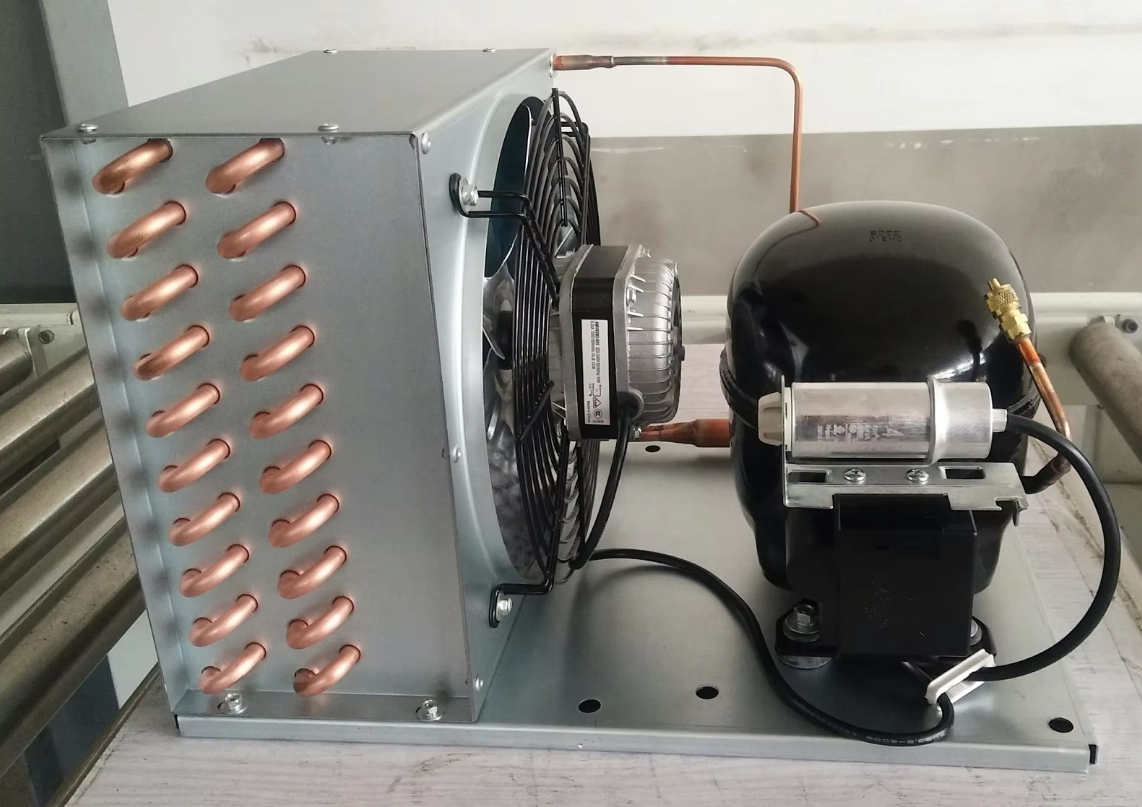
A condensing unit: compressor, fan and condenser coil. On a split system this part sits in a garage, attic or outside, and it needs open air around it.
1
Call with the model and the code
Tell us the model, what the display shows, and where the unit and its hot side are: through a wall, in the ceiling, in a closet or attic, in the garage or outside.
2
A heads-up before we arrive
You get a courtesy call or text with your technician’s name when they’re on the way. Shoe covers and a protective tool mat come with every visit.
3
We test the whole system
Temperatures on both sides, fans, probes, drainage, ducting and the refrigeration system, plus the condensing unit on a split system. You get a written estimate and decide whether to go ahead. Service call fee waived with completed repair.
4
Repair and verify
We finish the approved repair and check that the unit cycles normally. If a part has to be ordered, we tell you on the first visit and schedule the return.
What to have ready
The model and serial number from the label, a photo of the display, and photos of the unit’s front and of the hot side or condensing unit.
Customer reviews
What customers say about a Near visit
In their own words, from Google, Angi and Yelp. These jobs weren’t CellarPro units, but they show how our visits go.
★★★★★
“Both times he was prompt, got to work immediately, gave us an accurate assessment, offered advice to help the issue we had, and didn’t pressure us for additional services beyond what we had already set out to purchase.”
Daniel S. · Honest advice · Google review
★★★★★
“Great communication, personable and professional techs, and impressive care for your property. … They put on protective shoe covers before entering the house, placed a skid mat under the slide-in range before moving it, and placed another mat on my floors to hold various parts.”
Iverson W. · Care for your home · Angi review
★★★★★
“They saved me alot of money by repairing it instead of replacing it. The technician was very knowledgeable and professional, I will definitely continue to use them in the future for all my appliances!”
Jacqueline T. · Repair, not replace · Yelp review
Where we work
CellarPro repair across Edmond and the Oklahoma City metro
We come to homes in Edmond, Oklahoma City and the towns around them. Every technician lives in the area they service. Call (405) 534-4788 to confirm your address.
Do you repair CellarPro wine cellar cooling units?
Yes. We repair CellarPro 1800 Series and Houdini units, VS and VE Series self-contained units, split systems and air handlers in Edmond, Oklahoma City and nearby towns. Near Appliance Repair is an independent repair company, not affiliated with or endorsed by CellarPro.
What does HA2 mean on a CellarPro?
The hot side is overheating. The control watches the condenser coil and stops the compressor above 140°F until it cools down. The usual causes are a hot-side fan that has stopped, a clogged filter or coil, or a space behind the unit that is too hot or too small. If the hot-side fan isn’t spinning, switch the unit off and call us.
Why does my CellarPro run all the time?
Right after it is installed or loaded with warm bottles, running nonstop for up to a week is normal, and once the cellar settles it can run about 75 percent of the time. Constant running in an established cellar usually points to hot or blocked air on the hot side, a dirty filter, a door or wall that leaks, or a refrigeration fault.
Why is my CellarPro dripping water?
Cooling pulls moisture out of the cellar air, and the unit evaporates it from its drip pan. If the cellar leaks air, the set point is very low or the unit runs constantly, it makes more water than the pan can handle. A blocked drain line, a drain line without the trap its manual calls for, or a dirty pan can also cause overflow. Trap rules differ by model: the 1800H Houdini’s overflow line runs without one.
Why is my CellarPro icing up?
Ice on the cold-side coil means air isn’t moving across it or the unit isn’t shutting off. Common causes are a stopped evaporator fan, blocked ducting, a bottle probe in the wrong spot or with moisture in its plug, a split system wired so the condensing unit never stops, or low refrigerant. Switch the unit off, let the ice melt, and call us.
My CellarPro display says PoF. Is it broken?
No. PoF means the keypad is locked. Hold the up and down buttons together for 3 seconds, until “Pon” flashes, and it unlocks.
Can a CellarPro work in an Oklahoma garage?
It depends on the model and the garage. 1800 Series units need intake air between 40°F and 95°F, VS and VE units handle up to 110°F, and below 40°F any CellarPro needs a compressor heater (below 20°F, a fan cycling switch too). A garage that bakes in July or freezes in January can set off HA2 or LA2 alarms.
What temperature should I set my CellarPro to?
CellarPro ships its units with a 58°F minimum set point and a 4°F differential, so the cellar averages about 60°F. Its manual recommends a set point between 53°F and 60°F, and most collectors store wine at 55°F to 60°F. These units are made for storing wine, not for serving temperatures.
Do you work on CellarPro split systems?
Yes. We service the evaporator, the condensing unit and the refrigerant lines between them. Refrigerant work is done by EPA 608 Universal certified technicians.
How much does CellarPro repair cost?
It depends on what failed. A probe, fan or drain repair is a smaller job than refrigerant or compressor work, and attic or garage access can add time. You get a written estimate before any work starts. Service call fee waived with completed repair.
What warranty comes with a CellarPro repair?
Our repairs come with 1 year on labor and 1 year on qualified installed parts.
How soon can I get an appointment?
We schedule CellarPro repair visits 7 days a week, 9 AM to 6 PM. Call (405) 534-4788 for the next opening.
Is a CellarPro different from a wine fridge?
Yes. A CellarPro cools a whole room, so the room’s insulation, seals and airflow are part of the system. A freestanding or built-in wine refrigerator is a sealed cabinet; for those, see our wine cooler repair page.
Is your CellarPro alarming, dripping or running warm?
Call with the model and the code on the display, and we’ll set up a visit.
Related pages
Wine cellar cooling unit repair WhisperKOOL repair Wine cooler repair Sub-Zero wine storage repair Sealed system repair Mini-split refrigeration repair All brands we repairNear Appliance Repair is an independent appliance repair company, not affiliated with or endorsed by CellarPro. CellarPro is a trademark of its owner, used here only to describe the equipment we repair.